Mixed-Methods Education Researcher Micro-Credential | Online Mixed-Methods Research Certificate
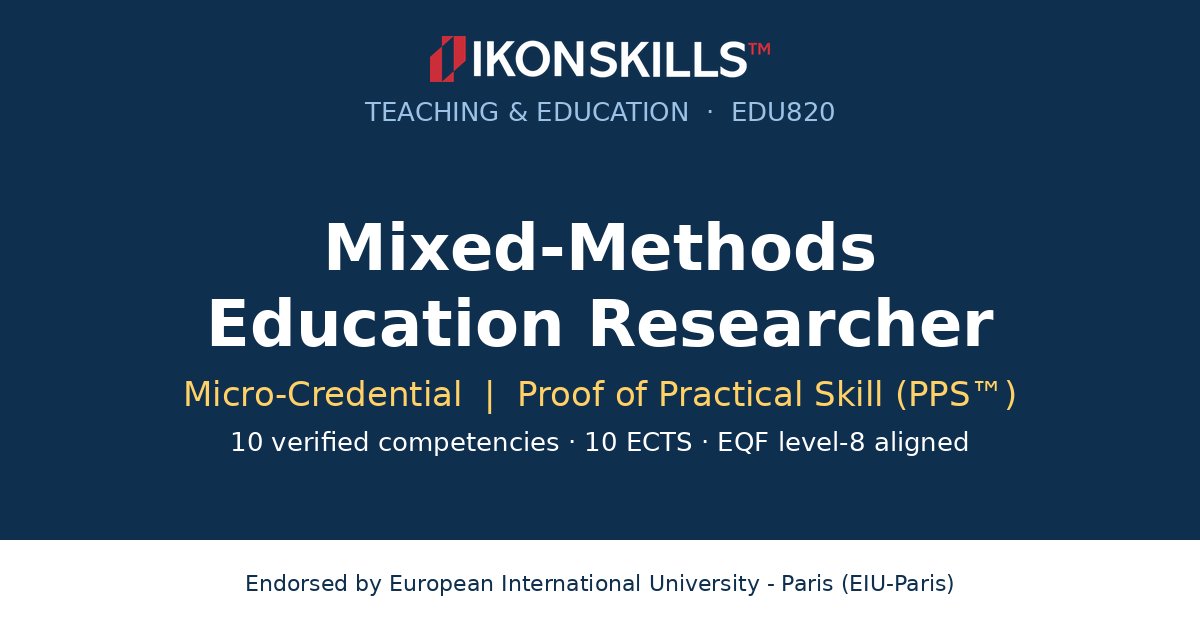
Mixed-Methods Education Researcher Micro-Credential: EQF level-8 aligned, 10 ECTS, PPS™ proof you can combine numbers and voices into clear evidence.
Mixed-Methods Education Researcher Micro-Credential: Numbers and Stories, Together
Quick answer: The Mixed-Methods Education Researcher Micro-Credential is an IKON SKILLS™ Micro-Credential in the Teaching & Education domain. It verifies 10 competencies in quantitative methods, qualitative methods, data triangulation, statistical modeling, interview design, survey construction, ethics protocols, research reporting, publication preparation and evidence synthesis. It carries 10 European Credit Transfer and Accumulation System (ECTS) credits, is European Qualifications Framework (EQF) level-8 aligned, is competency-based (at least 75% mastery across 10 Core Competencies), and is endorsed by European International University - Paris (EIU-Paris). It stacks toward the EIU-Paris Emerging Degrees for educators.
Yesterday we looked at how to test a school idea before you scale it. Today we ask a harder question. What happens when the numbers say one thing and the people say another? A test score can rise while students feel more stressed. Attendance can stay flat while teachers say the mood in the building has changed for the better. If you only look at one kind of evidence, you only see half the story. The Mixed-Methods Education Researcher Micro-Credential verifies that you can combine numbers and people’s voices to see the whole picture, and report it honestly.
This is Day 38 of our series on the 48 IKON SKILLS™ Micro-Credentials in the Teaching & Education domain. One a day. It is EQF level-8 aligned, the doctoral level, and written for research leads, doctoral-level practitioners, program evaluators, school improvement teams and educators who want evidence that is both strong and human.
What mixed-methods research really looks like
Mixed-methods research sounds technical, but the idea is simple. Numbers tell you what happened and how much. Words tell you why it happened and what it meant to the people involved. A mixed-methods researcher plans for both from the start, so each one can check and explain the other.
Picture a secondary school that has started a peer tutoring program in mathematics. After one term, the test results show a small gain, but only for some students. A mixed-methods researcher does not stop there. She runs a short survey for every student in the program and then holds small interviews with tutors, tutored students and teachers. The interviews show that sessions worked well when tutors had a clear plan, and fell apart when they did not. Now the school knows two things: the program can help, and tutor preparation is the key. That is what this Micro-Credential is about: answers that are measured and understood.
What the Mixed-Methods Education Researcher Micro-Credential verifies
The Micro-Credential covers 10 core competencies, each applied to doctoral educational research, policy analysis and systemic transformation:
- Quantitative methods
- Qualitative methods
- Data triangulation
- Statistical modeling
- Interview design
- Survey construction
- Ethics protocols
- Research reporting
- Publication preparation
- Evidence synthesis
Three deserve a closer look. Quantitative methods means working with numbers in a careful way: choosing what to measure, collecting it the same way each time and reading the results without stretching them. Qualitative methods means studying words, actions and experiences, through interviews, observations and open answers, and finding the patterns in them. Data triangulation means putting different kinds of evidence side by side. When the survey, the test data and the interviews all point the same way, you can trust the finding more. When they disagree, you have found something worth looking into.
Proof of Practical Skill (PPS™), not proof of attendance
Reading about research methods does not show that you can combine them in a real school. IKON SKILLS™ asks you to show what you can do. The assessment is competency-based on www.ikonskills.com, with classroom scenarios. You earn it only after showing at least 75% mastery across 10 Core Competencies. That is PPS™.
When you complete it, you receive a digital badge and a Certificate of Mastery to share on LinkedIn or add to your portfolio.
The facts, in one place:
- Name: Mixed-Methods Education Researcher
- Catalog code on IKON SKILLS™: EDU820
- Domain: Teaching & Education
- Level: EQF level-8 aligned
- Credits: 10 ECTS
- Competencies: 10 verified core competencies
- Assessment: competency-based, with at least 75% mastery
- Pace: self-paced, and the first Core Competency is free to try
- Fee: USD 14.99 per Micro-Credential
- Endorsed by: European International University - Paris (EIU-Paris)
See the Mixed-Methods Education Researcher Micro-Credential on IKON SKILLS™ →
Collecting both kinds of evidence well
Survey construction means writing questions that are short, clear and fair, so that every student or parent reads them the same way. Interview design means planning open questions that invite honest stories, not the answers people think you want. Statistical modeling means using the right tools to see whether a change is real or just chance, and which factors seem to matter most. Ethics protocols protect everyone in the study. You ask for proper consent, keep names and personal data safe, and make sure that taking part never puts a student or a teacher at risk.
Turning evidence into something people can use
Evidence synthesis means bringing many findings together, from your own study and from other research, into one clear message. Research reporting means writing up what you did and what you found so that others can follow it, check it and use it. Publication preparation goes one step further. You shape your work for a journal, an education event or a policy brief, and you choose the outlet whose readers most need to hear it. Good mixed-methods reports show the numbers and the voices together, so leaders can see both the size of a change and the reasons behind it.
Who this Micro-Credential is for
I would recommend it to these educators:
- Research leads and program evaluators who need to explain not only whether a program works, but why.
- School improvement teams who want to hear students and teachers, not only read their scores.
- Doctoral-level practitioners and policy advisors who prepare evidence for journals, boards and ministries.
From one Micro-Credential to an Emerging Degree
Every IKON SKILLS™ Micro-Credential is a step on a longer road. IKON SKILLS™ is endorsed by European International University - Paris (EIU-Paris), and Micro-Credentials stack toward the EIU-Paris Emerging Degrees:
- Bachelor of Future-Ready Teaching Practice (BFTP): stack 24 Micro-Credentials.
- Master of Education Innovation and Leadership (MEIL): stack 36 Micro-Credentials.
- Doctor of Professional Practice in Education (DProf.Ed): stack 48 Micro-Credentials.
If you have followed the series from Day 1, you now hold thirty-eight of the 48. You have the full 36 for the MEIL, and ten more to go for the DProf.Ed. This one builds directly on Day 37, Applied Education Research Specialist, which plans a fair test of a school idea, and adds the human side of the evidence. It also pairs with Day 21, Classroom Research Practitioner, which asks questions inside one classroom, and with Day 35, Institutional Education Data Analyst, which turns school data into clear answers. Tomorrow, Day 39, Action Research Systems Lead, shows how to make research a regular habit across a whole school or system.
Read about the BFTP, MEIL and DProf.Ed Emerging Degrees at EIU-Paris or see how the degree pathways work on IKON SKILLS™.
A small exercise for this week
Pick one number your school watches closely, such as attendance, homework completion or a test average. Write it at the top of a page. Below it, write one question the number cannot answer on its own, such as “Why do some students stop handing in homework in the second term?”
Then talk for ten minutes with three students or two colleagues, and write down what they say. Put their words next to the number. Do they agree? Do they explain it? You will have practiced, in miniature, what this Micro-Credential verifies: two kinds of evidence, side by side, giving a fuller answer.
Key takeaways
- The Mixed-Methods Education Researcher Micro-Credential (EDU820 on IKON SKILLS™) sits in the Teaching & Education domain.
- It verifies 10 competencies, including quantitative methods, qualitative methods, data triangulation and evidence synthesis.
- It carries 10 ECTS, is EQF level-8 aligned and is competency-based. You need at least 75% mastery across 10 Core Competencies.
- It costs USD 14.99 per Micro-Credential, and you receive a digital badge and a Certificate of Mastery when you complete it.
- IKON SKILLS™ is endorsed by European International University - Paris (EIU-Paris).
- It stacks toward the BFTP (24), MEIL (36) and DProf.Ed (48) Emerging Degrees.
Frequently asked questions
What is the Mixed-Methods Education Researcher Micro-Credential?
It is an IKON SKILLS™ Micro-Credential in the Teaching & Education domain. It verifies 10 core competencies in quantitative methods, qualitative methods, data triangulation, statistical modeling, interview design, survey construction, ethics protocols, research reporting, publication preparation and evidence synthesis. It carries 10 ECTS, is EQF level-8 aligned and is endorsed by European International University - Paris (EIU-Paris).
What is mixed-methods research in education?
It is research that uses both numbers and people’s words to answer one question. Test scores, attendance and survey ratings show what changed and by how much. Interviews, focus groups and open comments show why it changed and how it felt. Putting the two side by side gives a fuller and fairer picture.
How is the Mixed-Methods Education Researcher Micro-Credential assessed?
Assessment is competency-based on www.ikonskills.com. You earn it only after showing at least 75% mastery across 10 Core Competencies, using classroom scenarios. It is PPS™, not proof of attendance.
How much does the Mixed-Methods Education Researcher Micro-Credential cost?
IKON SKILLS™ Micro-Credentials are USD 14.99 per Micro-Credential. It is self-paced, so you can work through it alongside your other duties. You can also try the first Core Competency, Quantitative methods, free.
Can this Micro-Credential count toward a degree?
Yes. IKON SKILLS™ Micro-Credentials stack toward the EIU-Paris Emerging Degrees: the Bachelor of Future-Ready Teaching Practice (BFTP, 24 Micro-Credentials), the Master of Education Innovation and Leadership (MEIL, 36) and the Doctor of Professional Practice in Education (DProf.Ed, 48).
Start today
Begin with the Mixed-Methods Education Researcher Micro-Credential, or explore 1,013 Micro-Credentials across 40 domains, 10,130 Core Competencies and 152 Emerging Degrees in the IKON SKILLS™ Credential Catalog at www.ikonskills.com.
Ready for a degree? Apply for the EIU-Paris Emerging Degrees: the Bachelor of Future-Ready Teaching Practice (BFTP), the Master of Education Innovation and Leadership (MEIL), or the Doctor of Professional Practice in Education (DProf.Ed).
See you tomorrow for Day 39.
Dr. Edward Roy Krishnan