Academic Publishing Practitioner (Education) Micro-Credential | Online Academic Publishing Certificate
Academic Publishing Practitioner (Education) Micro-Credential: EQF level-8 aligned, 10 ECTS, PPS™ proof you can share your research with the world.
Academic Publishing Practitioner (Education) Micro-Credential: Share What Works With the World
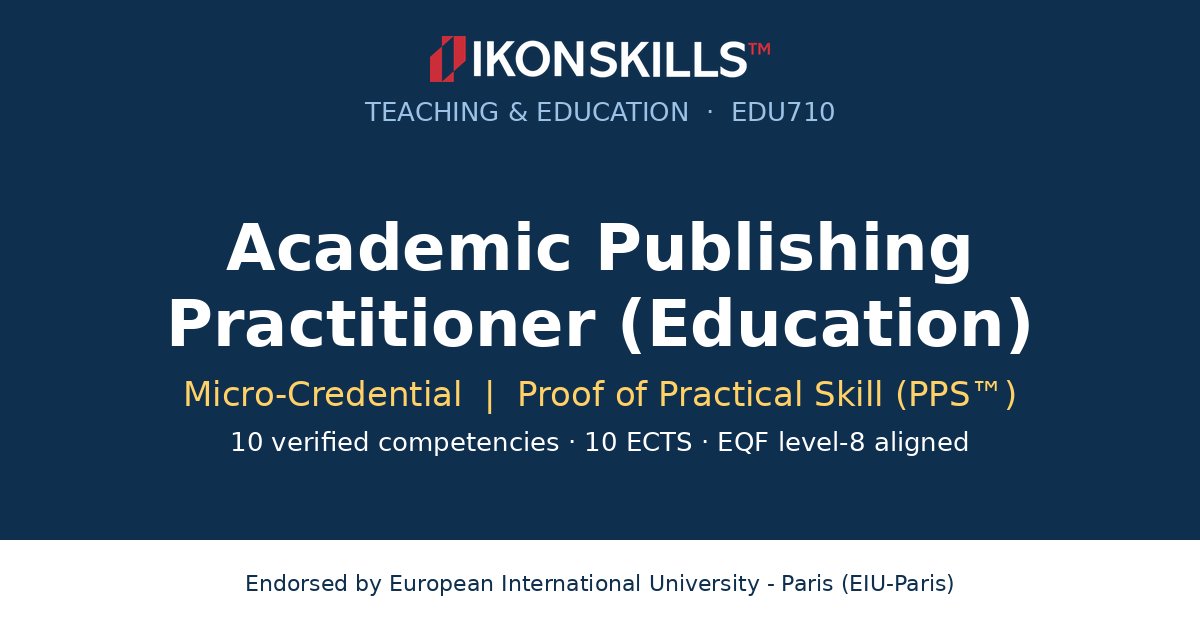
Quick answer: The Academic Publishing Practitioner (Education) Micro-Credential is an IKON SKILLS™ Micro-Credential in the Teaching & Education domain. It verifies 10 competencies in journal selection, manuscript preparation, peer review response, citation standards, ethics compliance, research visibility strategies, editorial collaboration, publication metrics analysis, knowledge translation and research impact reporting. It carries 10 European Credit Transfer and Accumulation System (ECTS) credits, is European Qualifications Framework (EQF) level-8 aligned, is competency-based (at least 75% mastery across 10 Core Competencies), and is endorsed by European International University - Paris (EIU-Paris). It stacks toward the EIU-Paris Emerging Degrees for educators.
Yesterday we built a system that helps a whole school keep and use what it learns. Today we open the door wider. Many teachers run careful studies, find something that really helps students, and then the finding stays in one staff room. A teacher in another city faces the same problem next year and never hears about it. The Academic Publishing Practitioner (Education) Micro-Credential verifies that you can take strong findings and share them with the wider world, through journals, reports and plain-language summaries that people can trust.
This is Day 40 of our series on the 48 IKON SKILLS™ Micro-Credentials in the Teaching & Education domain. One a day. It is EQF level-8 aligned, the doctoral level. It is written for teacher researchers, research leads, school and university leaders, doctoral candidates and educators who want their work to reach readers beyond their own school.
What academic publishing really asks of an educator
Publishing can look scary from the outside. It seems full of strange rules, long waits and harsh reviewers. In truth, it is a set of skills you can learn, one step at a time. You choose the right place for your work. You write it up clearly. You answer the questions of other experts. You follow fair rules for credit and ethics. Then you help people find and use what you wrote.
Picture a secondary school teacher who spent a year testing short daily writing tasks in her science classes. Her students explained their thinking more clearly, and her test results showed it. She could keep that story for one staff meeting. Or she could pick a journal that teachers actually read, write a clear article, answer the reviewers’ questions with care, and then share a one-page summary with her network. The second path turns one good year into help for many classrooms. That is what this Micro-Credential is about.
What the Academic Publishing Practitioner (Education) Micro-Credential verifies
The Micro-Credential covers 10 core competencies, each applied to doctoral educational research, policy analysis and systemic transformation:
- Journal selection
- Manuscript preparation
- Peer review response
- Citation standards
- Ethics compliance
- Research visibility strategies
- Editorial collaboration
- Publication metrics analysis
- Knowledge translation
- Research impact reporting
Three deserve a closer look. Journal selection means finding the right home for your work: a journal whose readers care about your topic, whose scope fits your study and whose review process is honest. It also means steering clear of journals that charge a fee but skip real review. Manuscript preparation means writing your study in the shape readers expect. That means a clear question, method, findings and meaning for practice. Peer review response means reading reviewer comments calmly, making the changes that improve the work and politely explaining any you do not make.
Proof of Practical Skill (PPS™), not proof of attendance
Reading about publishing does not show that you can do it. IKON SKILLS™ asks you to show what you can do. The assessment is competency-based on www.ikonskills.com, with classroom scenarios. You earn it only after showing at least 75% mastery across 10 Core Competencies. That is PPS™.
When you complete it, you receive a digital badge and a Certificate of Mastery to share on LinkedIn or add to your portfolio.
The facts, in one place:
- Name: Academic Publishing Practitioner (Education)
- Catalog code on IKON SKILLS™: EDU710
- Domain: Teaching & Education
- Level: EQF level-8 aligned
- Credits: 10 ECTS
- Competencies: 10 verified core competencies
- Assessment: competency-based, with at least 75% mastery
- Pace: self-paced, and the first Core Competency is free to try
- Fee: USD 14.99 per Micro-Credential
- Endorsed by: European International University - Paris (EIU-Paris)
See the Academic Publishing Practitioner (Education) Micro-Credential on IKON SKILLS™ →
Writing with care and honesty
Citation standards means giving fair credit to every idea you use, in the style the journal asks for, so readers can find your sources. Ethics compliance means following the rules that protect people in your study: consent, privacy for students and staff, honest reporting and no copying of other people’s work. Editorial collaboration means working well with co-authors, editors and reviewers. Agree early on who does what and whose names go on the paper, and keep everyone informed as the work moves forward.
Helping your work reach people and make a difference
Research visibility strategies means helping the right readers find your work. A clear title, good keywords, a short note to your network and a talk at a teacher event all help. Publication metrics analysis means reading numbers such as citations and downloads. It also means knowing what they can and cannot tell you. Knowledge translation turns a long article into something a busy teacher can use on Monday, like a one-page brief or a short guide. Research impact reporting closes the loop, describing what changed in classrooms, schools or policy because of the work.
Who this Micro-Credential is for
I would recommend it to these educators:
- Teacher researchers who have strong findings and want to share them beyond their own school.
- Research leads and school leaders who support colleagues in writing up and sharing their work.
- Doctoral candidates and university educators who need to publish their studies and show the difference they make.
From one Micro-Credential to an Emerging Degree
Every IKON SKILLS™ Micro-Credential is a step on a longer road. IKON SKILLS™ is endorsed by European International University - Paris (EIU-Paris), and Micro-Credentials stack toward the EIU-Paris Emerging Degrees:
- Bachelor of Future-Ready Teaching Practice (BFTP): stack 24 Micro-Credentials.
- Master of Education Innovation and Leadership (MEIL): stack 36 Micro-Credentials.
- Doctor of Professional Practice in Education (DProf.Ed): stack 48 Micro-Credentials.
If you have followed the series from Day 1, you now hold forty of the 48. You have the full 36 for the MEIL, and eight more to go for the DProf.Ed. This one builds on Day 37, Applied Education Research Specialist, Day 38, Mixed-Methods Education Researcher, and Day 39, Action Research Systems Lead. Those three help you find strong evidence. This one helps you share it. Tomorrow, Day 41, Education Policy Analyst, shows how research can shape the policies that guide whole school systems.
Read about the BFTP, MEIL and DProf.Ed Emerging Degrees at EIU-Paris or see how the degree pathways work on IKON SKILLS™.
A small exercise for this week
Pick one finding from your own classroom or school that you are proud of. Write it in five short sentences: the problem, what you tried, who took part, what the evidence showed and what other teachers could do with it.
Then find two journals or teacher magazines that publish work like yours. Read their aims and their guide for authors, and note which one fits your five sentences best. You will have taken the first step this Micro-Credential verifies: choosing the right home for your work before you start writing.
Key takeaways
- The Academic Publishing Practitioner (Education) Micro-Credential (EDU710 on IKON SKILLS™) sits in the Teaching & Education domain.
- It verifies 10 competencies, including journal selection, peer review response, ethics compliance and knowledge translation.
- It carries 10 ECTS, is EQF level-8 aligned and is competency-based. You need at least 75% mastery across 10 Core Competencies.
- It costs USD 14.99 per Micro-Credential, and you receive a digital badge and a Certificate of Mastery when you complete it.
- IKON SKILLS™ is endorsed by European International University - Paris (EIU-Paris).
- It stacks toward the BFTP (24), MEIL (36) and DProf.Ed (48) Emerging Degrees.
Frequently asked questions
What is the Academic Publishing Practitioner (Education) Micro-Credential?
It is an IKON SKILLS™ Micro-Credential in the Teaching & Education domain. It verifies 10 core competencies in journal selection, manuscript preparation, peer review response, citation standards, ethics compliance, research visibility strategies, editorial collaboration, publication metrics analysis, knowledge translation and research impact reporting. It carries 10 ECTS, is EQF level-8 aligned and is endorsed by European International University - Paris (EIU-Paris).
Why should teachers publish their research?
When a finding stays in one school, only that school can use it. Publishing in a journal or a clear report lets other teachers, leaders and policy makers learn from it, test it and build on it. It also adds weight to your own work, because other experts have checked it through peer review.
How is the Academic Publishing Practitioner (Education) Micro-Credential assessed?
Assessment is competency-based on www.ikonskills.com. You earn it only after showing at least 75% mastery across 10 Core Competencies, using classroom scenarios. It is PPS™, not proof of attendance.
How much does the Academic Publishing Practitioner (Education) Micro-Credential cost?
IKON SKILLS™ Micro-Credentials are USD 14.99 per Micro-Credential. It is self-paced, so you can work through it alongside your other duties. You can also try the first Core Competency, Journal selection, free.
Can this Micro-Credential count toward a degree?
Yes. IKON SKILLS™ Micro-Credentials stack toward the EIU-Paris Emerging Degrees: the Bachelor of Future-Ready Teaching Practice (BFTP, 24 Micro-Credentials), the Master of Education Innovation and Leadership (MEIL, 36) and the Doctor of Professional Practice in Education (DProf.Ed, 48).
Start today
Begin with the Academic Publishing Practitioner (Education) Micro-Credential, or explore 1,013 Micro-Credentials across 40 domains, 10,130 Core Competencies and 152 Emerging Degrees in the IKON SKILLS™ Credential Catalog at www.ikonskills.com.
Ready for a degree? Apply for the EIU-Paris Emerging Degrees: the Bachelor of Future-Ready Teaching Practice (BFTP), the Master of Education Innovation and Leadership (MEIL), or the Doctor of Professional Practice in Education (DProf.Ed).
See you tomorrow for Day 41.
Dr. Edward Roy Krishnan